In This Article:
TTMI
Sponsored
The AI Mirage: Unpacking the Hidden Gamma Trap in TTM Technologies
BearishStrongChange from report: -38.8%1M: -30.5%
Published on 2026-06-15 by TradeFomo
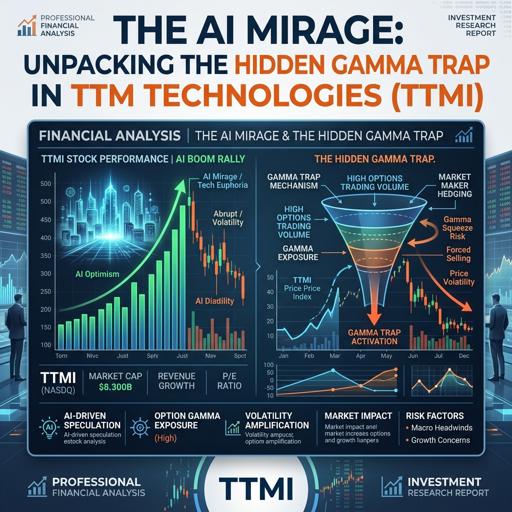
The mainstream financial narrative loves a straightforward triumph. TTM Technologies (TTMI), a legacy printed circuit board manufacturer, has seemingly reinvented itself as an irreplaceable cog in the AI and Data Center machine. The stock is up a staggering 430% over the past year, catapulting its market capitalization past $20 billion. With a record Q1 top-line of $846 million and the CEO confidently projecting $4 billion in revenue for the full year, the fundamental analysts are euphoric. Institutional giants like BlackRock and Vanguard have aggressively scaled into the name, filing 13Gs that cement the "smart money is long" thesis.
But when everyone is staring at the stars, someone has to inspect the plumbing. A deep dive into the over-the-counter block trades, liquidity metrics, and derivatives positioning paints a radically different picture. Behind the veil of retail euphoria, a sophisticated distribution phase is actively being engineered, masked by a massive near-term volatility squeeze.
The Plumbing: Off-Exchange Whispers and Price-Volume Divergence
Let us look at the actual market mechanics by synthesizing four critical metrics: the TRF ratio, short pct, volume Z-score, and rolling CLV. When we merge these indicators, they strip away the tape's lies to reveal hidden institutional maneuvering—specifically, stealth accumulation or distribution, abnormal fund flows, and severe price-volume divergences. Our rule of thumb is that if the TRF ratio and volume Z-score print recent extreme highs on the exact same day, a major new trend or structural shift is being birthed. This exact phenomenon occurred on May 29th: the TRF ratio hit the absolute 100th percentile while the volume Z-score spiked to an elevated 1.71. On that same day, the short pct in the over-the-counter market plunged to the 3rd percentile, and the rolling CLV collapsed to 0.10. This was not an aggressive short-selling attack; rather, it was institutions quietly dumping long inventory into a euphoric retail bid off-exchange, resulting in closing prices finishing at the absolute bottom of the intraday range. Fast forward to mid-June, and the narrative has maliciously inverted. While the stock has drifted back up to $194, the volume Z-score has turned deeply negative (-0.61 on June 12), yet the rolling CLV has rebounded sharply to 0.73. This is a classic, dangerous divergence: the intraday price action is being mechanically propped up to close near the daily highs on abysmal volume. Meanwhile, the TRF ratio remains highly elevated at the 91st percentile. Institutions are not outright shorting; they are utilizing this light-volume, engineered melt-up to seamlessly execute off-exchange block distributions. The buyers stepping in today are merely providing exit liquidity.
The Options Matrix: Dealers, Delta, and the Impending Gamma Unwind
If the equity tape suggests stealth distribution, the derivatives surface is screaming a warning of systemic tail risk. Let us examine the net GEX trend, the net DEX direction, and the shifting OTM put/call OI ratio. Currently, the market is sitting under a massive umbrella of positive gamma, with net GEX ballooning from 2.51 million on June 10 to over 5.05 million as of June 12. This extreme positive gamma state dictates that dealers are actively suppressing volatility—buying dips and selling rips—which creates an illusion of structural stability and mean-reversion. However, looking at the net DEX, the institutional direction remains overwhelmingly biased to the upside, boasting a net Delta exposure of over 406 million. The herd is heavily tilted long, but the smart money is quietly buying insurance. We can clearly track this in the OTM put/call OI ratio, which abruptly flipped from a complacent 0.74 on June 5 to a highly defensive 1.24 by June 12. This rapid accumulation of tail risk hedging is a glaring red flag that institutions are bracing for impact.
Term Structure and the Imminent Expiration Cliff
Analyzing the option open interest snapshot further reveals that the market is entirely dominated by near-term gamma. The June 18 expiration is hoarding the vast majority of the gamma exposure (3.55 million net GEX), effectively trapping the stock in a rigid corridor defined by a front put wall at $160 and a formidable call wall at $250. But the real danger lies in how the market is pricing the immediate future. The implied volatility skew is severely distorted: the 0-5 day IV for puts is trading at a staggering 1.397 versus just 0.850 for calls. The market makers are aggressively pricing in crash risk, entirely disconnected from the calm equity tape.
Once this heavily concentrated near-term gamma rolls off post-OpEx, the dealer-stabilizing effect will immediately vanish. Without the thick layer of positive GEX forcing mean-reversion, the accumulated downside tail risk will be violently unlocked. With volume already drying up on the underlying stock, the air pocket below current prices is vast, exposing the macro put wall at $165 (July 17) as the true gravitational center for the next leg of this market cycle.
The Illusion of Liquidity
TTM Technologies is a textbook example of narrative acting as a camouflage for structural exit strategies. The fundamentals are undeniably strong, but the market is a discounting mechanism that has already priced in perfection. The convergence of off-exchange distribution, fading on-exchange volume, massive long Delta exposure, and aggressively bid short-term put skew tells us one thing: the music is slowing down. When the near-term gamma expires and the dealers pull their stabilizing bids, the resulting vacuum will remind investors that liquidity is an illusion precisely when it is needed the most.
Sponsored