In This Article:
PRLD
The Shadow Accumulation of Prelude Therapeutics: Why The Obvious Dilution is a Trap
BullishStrongChange from report: -2.1%1M: -13.0%3M: -18.5%
Published on 2026-04-24 by TradeFomo
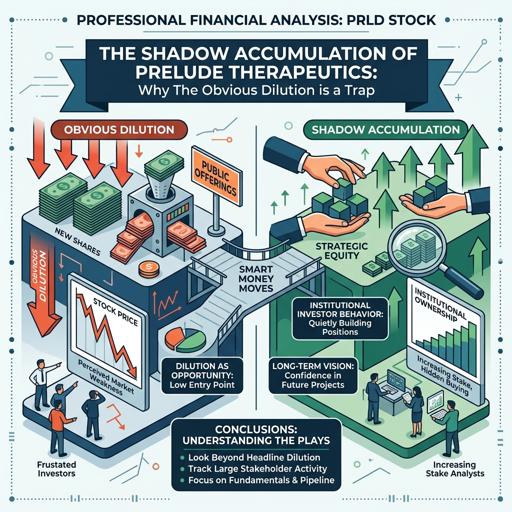
The Illusion of the "Toxic" Offering
Most retail investors see an $85.5 million secondary stock offering that dilutes the float by roughly 30% and instantly hit the sell button. Conventional Wall Street wisdom dictates that massive equity dilution, especially for a cash-burning clinical-stage biotech company, is a death knell for near-term price action. But conventional wisdom rarely looks under the hood.
On April 20, 2026, Prelude Therapeutics (PRLD) announced they were selling over 18 million shares at $4.44, led by institutional heavyweights like RA Capital Management and Soleus Capital. Predictably, the retail crowd panicked. Yet, look at the tape: the stock hasn't collapsed. In fact, it continues to base comfortably around the $4.40 mark. Why? Because this wasn't a desperate bailout; it was an orchestrated, closed-door land grab by smart money. SEC filings confirm that OrbiMed Advisors, who already held a board seat, devoured millions of shares in this very offering, bringing their total stake to a staggering 16%. When insiders and tier-one healthcare funds willingly eat a 30% dilution at market price, they aren't preparing for bankruptcy—they are securing their seats for a clinical catalyst.
The Dark Pool Tape: Reading Institutional Fingerprints
To truly understand what is happening beneath the surface, we need to ignore the mainstream media and look at the market's plumbing.
Let us analyze the linkage between four crucial metrics: the off-exchange volume percentage (often called the TRF ratio), the off-exchange short volume percentage, the volume Z-score, and the rolling close location value. When viewed collectively, these four metrics expose the hidden maneuvers of institutional players—revealing shadow accumulation, stealth shorting, abnormal capital flows, and critical price-volume divergences. As a rule of thumb, if the TRF ratio and the volume Z-score print near-term extremes on the exact same trading day, it acts as a mechanical ignition switch for a new macro trend. Meanwhile, the trajectory of the rolling close location value strips away intraday noise and betrays the true multi-day conviction of buyers versus sellers at the closing bell. Let's apply this to Prelude's recent tape. On April 15, Prelude's volume Z-score violently spiked to an extreme 2.81, while the TRF ratio simultaneously dropped to a severe low percentile. This dual extreme was our ignition signal: it meant institutions were bypassing the dark pools to aggressively hit the ask on lit exchanges, signaling a powerful new upward structural trend ahead of the offering. Following the offering's close, on April 23, we saw another telling print. The volume Z-score flashed an elevated 1.13 alongside another extreme bottom in the TRF ratio. Importantly, despite the massive influx of newly issued shares, the rolling close location value quickly recovered to nearly 0.50, propelled by a daily close location value of 0.94. The off-exchange short volume percentage remained relatively normalized during this absorption phase. My synthesized judgment is definitive: the smart money is not flipping their newly acquired shares. Instead, they are utilizing lit-market liquidity to fiercely defend their $4.44 cost basis, turning an event that normally triggers a distribution phase into a massive bullish accumulation base.
The Options Anomaly: The April 20 Volatility Spike
Let's talk about the derivatives market, which often acts as the tail that wags the dog. On April 20, the day the public offering was announced, we saw a massive anomaly in the options chain.
The Put/Call Distortion
Total options volume spiked to 1,684 contracts against an average daily volume that typically sits in the low double-digits. Even more fascinating was the put/call volume ratio, which exploded to 4.21.
A novice trader sees a massive spike in puts and assumes the street is betting on a crash. That is a fundamental misinterpretation of market mechanics. Given the context of an $85.5 million secondary offering pricing the very next day, these puts were almost certainly married puts or delta-hedging strategies deployed by the participating funds and underwriters. They were locking in synthetic floors for their massive new equity allocations. This kind of institutional hedging effectively absorbs the downside volatility. Once the offering closed and the hedges began to decay, it removed the delta-hedging weight off the underlying equity, leaving a vacuum where only upside pressure remains.
The Clinical Horizon: Valuing the Unseen
If the tape shows us what the institutions are doing, the pipeline tells us why they are doing it. Prelude's current market cap is sitting near $276 million, a microscopic valuation given the balance sheet runway they just secured.
The $85.5 million raise extends their cash runway deep into the second quarter of 2028. This completely removes the existential financing overhang that plagues 90% of micro-cap biotechs. More importantly, it funds them past two critical inflection points:
- PRT12396 (JAK2V617F Inhibitor): FDA IND clearance was secured in February 2026. Phase 1 dosing for myeloproliferative neoplasms is expected to initiate by Q2 2026.
- PRT13722 (KAT6A Degrader): The company just presented stellar preclinical data at the AACR Annual Meeting, demonstrating synergistic complete tumor regressions when combined with CDK4/6 inhibitors for breast cancer. An IND filing is slated for mid-2026.
Institutions aren't stupid. They see a company trading at roughly a $170 million enterprise value (backing out the newly bolstered cash reserves) that possesses a clinical-stage targeted protein degrader and a mutant-selective JAK2 inhibitor. The big pharma premium for these exact mechanisms is typically measured in the billions, not millions.
The Verdict
The retail herd was spooked by the word "dilution," missing the forest for the trees. The data is screaming at us: extreme lit-exchange volume accumulation, institutional put-hedging to establish a floor, heavy insider and tier-one fund participation at the exact offering price, and a rolling close location value that proves buyers are eagerly stepping up at the closing bell.
Prelude Therapeutics is not being diluted to death; it is being capitalized for a major fundamental revaluation. The smart money has built their fortress at the $4.40 level. Betting against them here isn't just contrarian—it's bad math.