In This Article:
POET
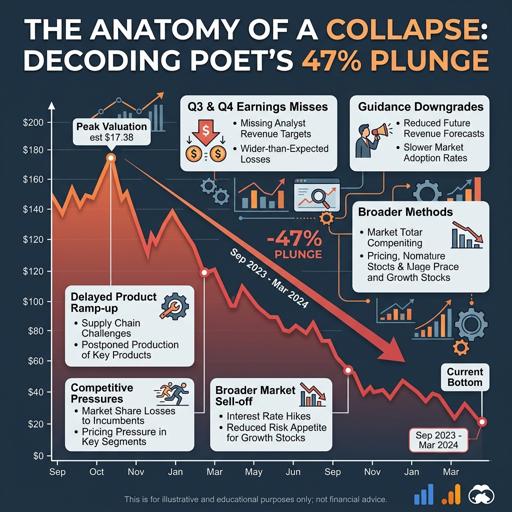
The Anatomy of a Collapse: Decoding POET's 47% Plunge
BearishStrongChange from report: -20.7%1M: +65.1%3M: -15.8%
Published on 2026-04-28 by TradeFomo
The AI Mirage and the Marvell Reality Check
We've seen this movie before. A small-cap tech stock catches the artificial intelligence tailwind, announces a slew of acronym-heavy partnerships—1.6T transceivers, CPO, ELSFP—and its valuation goes parabolic. POET Technologies was the latest protagonist. From lingering under $6 in early March to a dizzying $15.10 high by April 24, the market was pricing in flawless execution and endless growth.
Then came Monday, April 27, 2026.
POET’s stock was entirely decapitated, plunging 47.35% to close at $7.95. The catalyst? A morning SEC Form 6-K detailing that Marvell Semiconductor had canceled all purchase orders for Celestial AI due to POET's breach of confidentiality obligations. Retail investors were completely blindsided by the devastating news. But if you look beneath the hood at the derivatives tape and the dark pools, the smart money had been quietly heading for the exits—and aggressively shorting—days before the news ever reached the public.
The Options Market Seldom Lies
Let’s look at the options data. Throughout February and March, total daily options volume for POET rarely eclipsed 40,000 contracts, and the put/call volume ratio hovered complacently between 0.06 and 0.16. Fast forward to the week of the crash. On April 20, volume surged abnormally to over 169,000 contracts. By Friday, April 24—the absolute peak of the rally and the last trading session before the Marvell news hit the wire—total options volume exploded to an unprecedented 334,670 contracts.
More damning was the put/call volume ratio, which spiked to 0.37 on that Friday. The sudden open interest expansion, combined with a massive surge in put activity, strongly indicates that institutional players were either aggressively hedging their long exposure or taking highly convicted downside bets with advance knowledge of the deteriorating relationship with Marvell.
The Dark Pools and Institutional Fingerprints
To truly understand the structural decay that preceded this crash, we must examine the interconnectedness of the off-exchange volume ratio, the off-exchange short ratio, the Volume Z-score, and the rolling close position value. Combined, these four indicators act as a polygraph for institutional intent, revealing hidden shorting, anomalous capital flows, and severe price-volume divergence. A reliable heuristic in market microstructure is that when the off-exchange volume ratio and the Volume Z-score simultaneously register extreme values on the same day, a new directional trend is likely being born. We witnessed this exact phenomenon between April 22 and April 27, where unprecedented Volume Z-scores (exceeding 2.4 standard deviations) coincided with extreme lows in the off-exchange volume ratio. While the surface-level price was making new yearly highs on April 22, the off-exchange short ratio was simultaneously maxing out at the 100th percentile. This exposed a massive, hidden institutional short accumulation—a classic volume-price divergence where smart money aggressively provided exit liquidity into retail euphoria. Furthermore, the rolling close position value, which tracks the balance of multi-day long versus short power at the closing bell, began to falter despite the higher prices, eventually cratering to a daily value of just 0.154 by the time the panic selling commenced. My comprehensive judgment, based on the recent trajectory of these four metrics, is that institutions executed a highly coordinated distribution and short-selling campaign in the dark pools just days before the Celestial AI cancellation became public, deliberately trapping late buyers and initiating a ferocious new downtrend.
Follow the Paper Trail
When you look at the filings and see MMCAP International—a Cayman Islands-based fund—reporting a newly acquired 9.99% stake (over 14.4 million shares, largely via warrants) back in February, you have to ask yourself who was providing the supply during the run-up to $15. The aggressive, euphoric rally throughout late March and April provided the perfect liquidity event for early warrant holders to dump their diluted equity onto retail momentum chasers.
The company's recent Q4 2025 financials, filed on April 1, highlighted a net loss of $42.7 million and negative cash flow from operations, masked only by a massive $375 million in equity financing rounds. The core business is effectively a cash incinerator leaning heavily on forward-looking promises. The Marvell cancellation doesn't just hurt the immediate bottom line; it shatters the thesis of unassailable execution that was holding the entire valuation together.
What Happens Next?
POET’s next earnings date is slated for May 13, 2026. The technical damage is catastrophic. The stock is now printing massive abnormal volume compared to its 3-month moving average, trading nearly 200 million shares on April 27 against an average of roughly 12 million. Short interest as a percentage of the float was already sitting near 10% in mid-April, and the momentum has violently shifted.
Contrarians might look at a 47% drop as an asymmetrical buying opportunity, hoping the isolated $5 million purchase order from other customers will stem the bleeding. I see it differently. The institutional trust is broken, the dark pool plumbing confirms aggressive systemic shorting right at the top, and the overhead supply from trapped retail buyers will act as a concrete ceiling on any relief rallies. Until the rolling close position value stabilizes and off-exchange short pressure recedes from its current extreme percentiles, catching this falling knife is a fool's errand. The smart money already made their move in the shadows. Don't be their exit liquidity twice.