In This Article:
ONTO
Sponsored
The Semiconductor Darling's Hidden Timebomb: Why Onto Innovation is Flashing Red
BearishStrongChange from report: -15.7%1M: -16.5%
Published on 2026-06-18 by TradeFomo
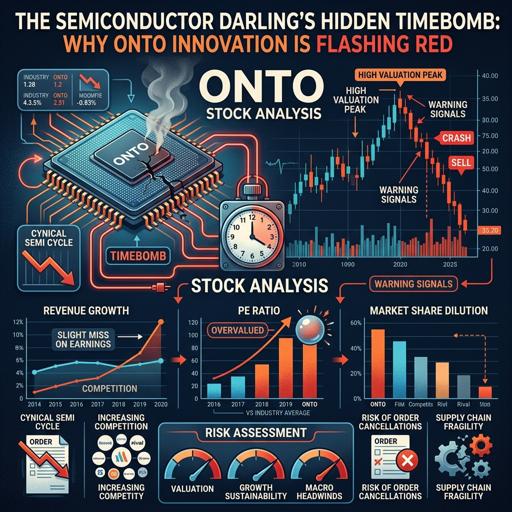
If you only look at the surface-level metrics, Onto Innovation (ONTO) looks like a flawless semiconductor machine. The stock is up over 222% in the last year, Q1 revenues hit a record $292 million, and management just locked in a massive $1.5 billion 0.00% convertible senior note offering while acquiring a strategic 27% stake in Rigaku. Wall Street is cheering, retail investors are aggressively bidding up the price, and the moving averages are all pointing toward the sky.
But if you strip away the headline euphoria and dive into the market microstructure—specifically off-exchange flows and options dealer positioning—a much darker, deeply contrarian narrative emerges. The "smart money" is not buying this breakout. They are distributing shares into retail liquidity, hiding in dark pools, and aggressively buying catastrophic tail-risk insurance. We are standing on the edge of a structural pricing cliff.
The Dark Pool Divergence: A Masterclass in Institutional Distribution
To understand what the big players are actually doing, we must conduct a combined analysis of the TRF ratio, the off-exchange short volume percentage, the volume Z-score, and the rolling CLV (close location value). When analyzed together, these four indicators are currently screaming that an institutional rug-pull is being orchestrated behind closed doors. On June 16, the TRF ratio (trade reporting facility, representing off-exchange dark pool volume) hit the absolute 100th percentile of its historical range, perfectly coinciding with extreme elevated levels in the off-exchange short percentage. Yet, on that exact same day, the volume Z-score abruptly cooled into negative territory, and it continued to plunge to an icy -1.15 by June 17. When the TRF ratio spikes to an absolute maximum while the volume Z-score collapses, it is a textbook microstructure signal that a prior trend is utterly exhausted and a reversal is imminent. Furthermore, the rolling CLV—which measures where the stock closes relative to its daily high-low range—completely evaporated to near-zero levels (0.005 on June 16 and 0.003 on June 17). This indicates complete exhaustion of bullish momentum; despite intraday price spikes, sellers are ruthlessly stepping in and slamming the price down into the daily close. This combination reveals a massive, hidden shorting operation: institutions are routing their short sales through dark pools to avoid spooking the public tape, perfectly executing a bearish divergence while retail provides the exit liquidity.
The Expiration Cliff and the Tail-Risk Warning
The options market is confirming this bleak setup, presenting a highly unstable volatility structure that is primed to break. Looking at the trend in Net GEX (gamma exposure), we saw a critical flip from negative territory on June 10 into a massive positive reading of roughly 6.99 million by June 17, while Net DEX (delta exposure) ballooned past 200 million. While a positive Net GEX usually anchors a stock and promotes mean reversion, the impending danger lies entirely in the expiration structure. The snapshot reveals that a staggering 5.46 million of that Net GEX is concentrated in the immediate June 18 front-end options. Dealers have established a massive call wall at the $320 strike, which has acted as a mechanical magnet, pinning the stock and artificially suppressing volatility. However, once this Friday's OPEX passes, that gamma pin will vanish, effectively pulling the floor out from under the market. Institutional players know this, which is why the OTM put to call OI ratio exploded from a docile 0.68 to a breathtaking 4.14 just days ago, and remains highly elevated. They are overwhelmingly long delta, but they are panic-buying downside protection. This panic is explicitly priced into the volatility term structure: the implied volatility for 0-5 day puts is sitting at a ludicrous 3.822, compared to just 0.509 for calls. The market is aggressively pricing in severe downside skew and near-term tail risk. When the $320 call wall expires and dealer hedging flows reverse, there is virtually no structural support until the macro put wall all the way down at $260.
The Financial Engineering Illusion
You might ask, "But didn't the company just announce a concurrent $300 million share repurchase program?" Yes, they did, and that is exactly the trap.
When Onto Innovation priced its $1.5 billion convertible notes, they used a portion of the proceeds to buy their own stock concurrently. This forced, mechanical buying perfectly explains the abnormal volume and aggressive upward price drift we saw in mid-May. The goal was simple: pump the stock price in the short term to set a higher initial conversion price ($381.80) for the notes, thereby minimizing future equity dilution.
But that artificial, price-insensitive buying is now effectively over. The helium has been cut off from the balloon.
The Verdict
We have a stock trading at multi-year highs, driven by corporate financial engineering that has now run its course. Beneath the surface, the TRF ratio and closing location values show that institutions are ruthlessly shorting the stock in dark pools every time it ticks up. In the options market, extreme gamma concentration at the $320 strike is masking immense fragility, while the smartest players in the room are paying a 7x premium for extreme short-term put volatility.
Once the June OPEX clears and the dealer gamma pin is removed, the structural support holding ONTO at these altitudes will evaporate. If you are holding long, you are holding the bag for the institutions who have already hedged their downside and sold you their shares in the dark. Watch the macro support at $260—because the journey down there could be much faster than the climb up.
Sponsored