In This Article:
IDYA
The Darovasertib Mirage: Decoding the Hidden Institutional Exit in IDYA
BearishStrongChange from report: +9.4%1M: -10.8%3M: +13.3%
Published on 2026-04-14 by TradeFomo
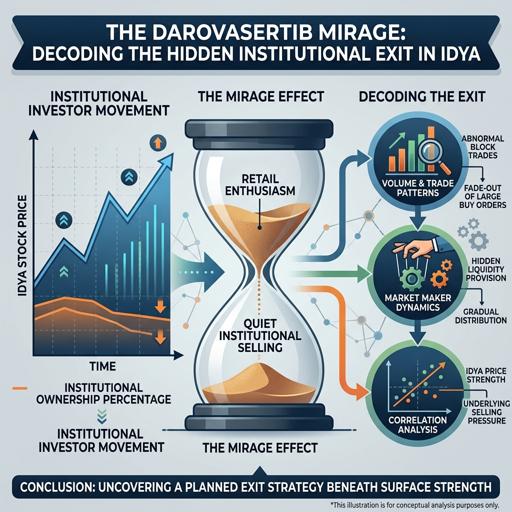
When a clinical-stage biotech announces positive Phase 3 registrational data, the retail reflex is to hit the "buy" button. The algorithmic headlines write themselves: "Statistically Significant," "58% Reduction in Risk of Disease Progression," "NDA Submission Planned." This is exactly what happened on April 13, 2026, when IDEAYA Biosciences (IDYA) released its OptimUM-02 results for Darovasertib in metastatic uveal melanoma. The stock gapped up, volume exploded to over 10 million shares, and the retail euphoria was palpable.
But if you look under the hood of the market's plumbing—away from the press releases and into the off-exchange dark pools—a vastly different, far more cynical narrative emerges. The smart money isn't buying the cure; they are selling the news.
The Setup: A Manufactured Liquidity Event
To understand what happened on April 13, we have to rewind. IDEAYA has been a battleground stock since late 2025. In December, GSK terminated their collaboration on the Werner and Pol Theta programs. The stock took a hit, but IDEAYA was saved by a $210 million upfront payment from Servier and a massive $1.1 billion cash pile that guarantees runway into 2030.
Throughout Q1 2026, the institutional positioning was bizarre. We saw Point72 (Steve Cohen) unveil a 2.1% stake, while Capital Research grew its position to 6%. Insider Jeffrey Stein bought $1.6 million worth of stock in early March at around $32.95. The narrative was heavily managed. They knew the Phase 2/3 OptimUM-02 trial had hit its 130 PFS events in February. They knew the data was coming in late March or early April.
And then, the off-exchange shorting began. Between March 20 and March 30, short interest as a percentage of the float climbed over 11%. But more importantly, our multidimensional signals flagged a persistently "very_bear" micro-state. Institutions were building a massive volatility trap, preparing for the ultimate liquidity event.
The Anatomy of an Institutional Distribution
To truly grasp the contrarian reality of IDYA’s current price action, we must conduct a synthesized analysis of four critical, interconnected market structure metrics: the TRF ratio (off-exchange trading dominance), the TRF short percentage, the 20-day Volume Z-Score, and the 5-day Rolling Close Position Value (CPV). When analyzed in unison, these metrics act as an X-ray of hidden institutional flow. On April 13, IDYA triggered a massive Volatility Z-Score of +5.66—a multi-sigma volume explosion (over 10 million shares against a 1 million average)—coinciding with an extreme TRF percentile of 0.80. Normally, a simultaneous peak in TRF ratio and Vol Z-Score signals the violent birth of a new directional trend. However, the exact nature of that trend is betrayed by the final two metrics. In the weeks prior, the TRF short percentage was pinned near the absolute maximum (1.0 percentile), indicating aggressive dark pool shorting. On the day of the news, this short percentage rapidly decayed to the 0.45 percentile as institutions aggressively covered their shorts into the retail buying frenzy. Yet, the most damning piece of evidence is the Rolling CPV. Despite a +19.76% intraday jump, the CPV on April 13 plummeted to a dismal 0.2348. A low CPV means the stock consistently closed near the bottom of its daily range (IDYA hit $38.10 intraday but was walked all the way down to close at $32.82). This precise combination—historic volume, extreme off-exchange activity, retreating short pressure, and a collapsing CPV—is the textbook structural signature of a "dark distribution." Institutions used the retail euphoria of the Phase 3 data not to build long positions, but to manufacture enough liquidity to exit their prior hedges and dump underlying inventory at premium intraday prices, leaving retail holding the bag by the closing bell.
The Options Market Knew
If the dark pool data wasn't enough to convince you, look at the derivatives market. In early April, option volumes began behaving erratically. On April 7 and 8, total option volume exploded to over 11,000 and 12,000 contracts, respectively, with open interest surging to 54,073 contracts.
The Put/Call ratio on volume leading up to the event was heavily skewed. On April 6, the rolling volume signal triggered an "abnormal volume 5ma" alert, and by April 7, the MACD flashed a "dead cross below zero." The options market makers were aggressively pricing in the volatility crush that would follow the data release. They knew that once the binary event passed, implied volatility would collapse, crushing premium buyers on both sides.
The Reality of the Pipeline
Let’s step back from the market structure and look at the fundamental reality. The OptimUM-02 trial was indeed a success. A median PFS of 6.9 months for Darovasertib + Crizotinib versus 3.1 months for the investigator's choice is a win.
But is it a fundamentally game-changing win that justifies chasing a $2.88 billion market cap after a 5-sigma volume event? The NDA submission isn't planned until the second half of 2026. There is a massive, catalyst-free desert stretching out before this company for the next six to eight months. AstraZeneca's recent collaboration for IDE849 in SCLC is promising, but it is deeply early-stage Phase 1/2. The GSK termination of the Werner/Pol Theta programs leaves a notable hole in their mid-stage pipeline.
The Contrarian Verdict
IDYA is a well-capitalized biotech with a genuinely interesting precision medicine engine. But the stock currently represents a classic post-catalyst trap.
The institutions that accumulated shares in Q1 and aggressively shorted off-exchange in late March just executed a flawless distribution event. They used the Phase 3 headline to generate a 10-million-share liquidity pool, covered their shorts, dumped their long inventory at the $38.10 intraday peak, and walked the stock down to $32.82 by the close.
When the smart money creates a 5-sigma volume event off-exchange but refuses to support the closing price (as evidenced by a 0.23 CPV), you do not want to be the one buying the shares they are discarding. Expect IDYA to bleed out slowly over the coming months as the retail euphoria fades, the volatility premium collapses, and the market realizes the next major catalyst is over half a year away.