In This Article:
HCA
Sponsored
The Terminal Diagnosis for HCA: Why the Fundamentals Are a Trap
BearishStrongChange from report: +7.6%1M: -2.8%
Published on 2026-06-16 by TradeFomo
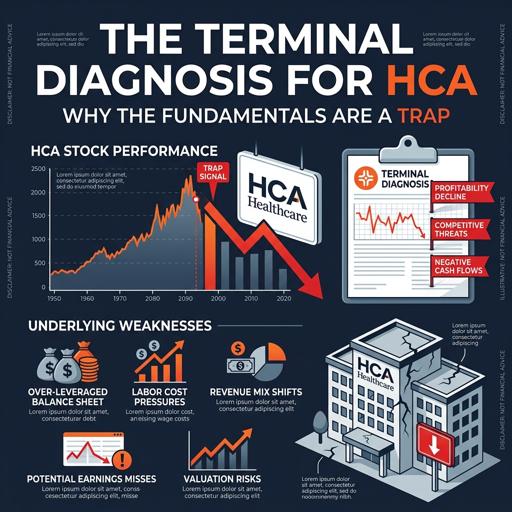
The Facade of Health: Debt, Dividends, and the Retail Trap
On the surface, HCA Healthcare appears to be the picture of fundamental stability. In their recent Q1 2026 earnings, they reported a solid EPS of $7.15 with rising revenues, and standard institutional filings recently highlighted Vanguard taking a 5.25% passive stake. To the untrained eye, the massive drop from the $510 highs in mid-March to the $360s in early June was merely a healthy market correction, and the recent mechanical bounce to $390—sparked by deeply oversold RSI levels—looks like the perfect entry point. The company even recently issued $3 billion in senior unsecured notes to "optimize" their capital structure. However, this is the classic Wall Street playbook. Behind the veneer of dividend declarations and debt issuance, institutional players have been aggressively distributing their shares into the hands of unsuspecting retail investors. The real market is not traded on backward-looking earnings reports; it is traded on hidden leverage and off-exchange plumbing.
Shadow Liquidity: The Off-Exchange Contradiction
Let’s dissect the shadow liquidity and price-volume divergence by combining four critical metrics: the TRF ratio, Short percentage, Volume Z-score, and Rolling CLV. When analyzed together, these indicators reveal the true underlying institutional behavior—specifically hidden OTC shorting or longing, abnormal fund flows, and manipulative price-volume divergence. Historically, when the TRF ratio and the Volume Z-score print recent extreme highs on the exact same day, it acts as a reliable flare that a new trend is about to ignite. We saw precisely this phenomenon unfold on June 1st, when an extreme TRF ratio aligned with a massive Volume Z-score spike, acting as the catalyst for the violent flush down toward the $360s. Now, as the stock attempts to bounce, we are witnessing a severe structural divergence. The Rolling CLV trend, which gauges the directional power of closing positions, has steadily climbed from its lows to reach 0.617, suggesting that some surface-level buyers are trying to assert control and push the price higher into the daily close. However, the Short percentage in off-exchange venues has simultaneously skyrocketed to the 93.3rd percentile as of June 15. This glaring contradiction—relentless hidden shorting absorbing the artificially strong closing strength—screams of institutional distribution. They are using the retail-driven bounce as a dark liquidity pool to quietly establish massive short lines.
The Gamma Trap: Systematic Downside Amplification
Turning our attention to the options time-series data, the market's internal mechanics paint an incredibly precarious picture. Monitoring the net GEX trend is crucial, as the transition nodes between positive and negative regimes historically map directly to major price inflection points. However, HCA’s net GEX has been violently trapped in negative territory, expanding from a mild -$3.9 million in late May to a staggering -$13.08 million by mid-June. In this negative gamma regime, market makers are forced to sell into weakness and buy into strength, inherently amplifying volatility and preventing any stable mean reversion. Alongside this, the net DEX sits at a massive -$68 million, unequivocally confirming that the institutional overall exposure remains aggressively skewed to the short side. But perhaps the most alarming signal is the rapid evolution of the OTM put/call OI ratio. In just two weeks, this ratio has violently tripled, surging from a complacent 0.21 in early June to an alarming 0.62 by June 15. This relentless accumulation of out-of-the-money puts indicates that smart money is actively hoarding tail-risk protection. The plumbing is signaling that a severe downside fracture is actively being priced in.
The Imminent Cascade: Breaking the Options Walls
A granular look at the current options open interest snapshot exposes exactly how the market is pricing the immediate future. The structural support and resistance of the underlying price are defined by key options walls, and currently, the front-month put wall is ominously pinned at the $380 strike with an overwhelming -$13.9 million in gamma exposure. Oddly, the nearest call wall sits lower at $375, acting as an inverted resistance block below the current price. When we evaluate the GEX distribution across expirations, it is unequivocally clear that near-term gamma completely dominates the landscape. The imminent June 18 expiration alone commands an explosive -$16.1 million in net GEX, dwarfing the far-term expirations and confirming that the immediate price action is highly vulnerable to a sudden gamma-driven cascade. Furthermore, examining the term structure and implied volatility skew reveals a severe pricing anomaly. In the 0-5 day window, while the open interest favors puts (8,492 puts vs. 5,568 calls), the implied volatility for calls is astronomically high at 2.657 compared to just 1.359 for puts. This extreme volatility skew in the ultra-short term suggests the market's pricing expectation is intensely bipolar: market makers are preparing for a brutal drag down to the $380 put wall abyss, while simultaneously charging exorbitant premiums for upside calls to protect against sudden, low-probability mechanical short-squeezes before the real collapse occurs.
Conclusion: The Patient is in Critical Condition
HCA Healthcare is currently a masterclass in market deception. While the fundamentals and recent credit maneuvers project an image of operational stability, the underbelly of the stock tells a story of aggressive institutional exiting and extreme downside positioning. The hidden off-exchange shorting is capping the current recovery, the negative gamma regime is primed to accelerate any selling pressure, and the aggressive accumulation of tail-risk puts is the smoking gun. This is not a dip to buy; it is a meticulously engineered trap. Watch the $380 level closely—if that put wall fractures, the resulting gamma cascade will be unforgiving.
Sponsored