In This Article:
FLUT
Sponsored
The FanDuel Illusion: Why Flutter's LSE Delisting is Masking a Massive Gamma Trap
BearishStrongChange from report: -9.2%1M: -14.9%
Published on 2026-07-09 by TradeFomo
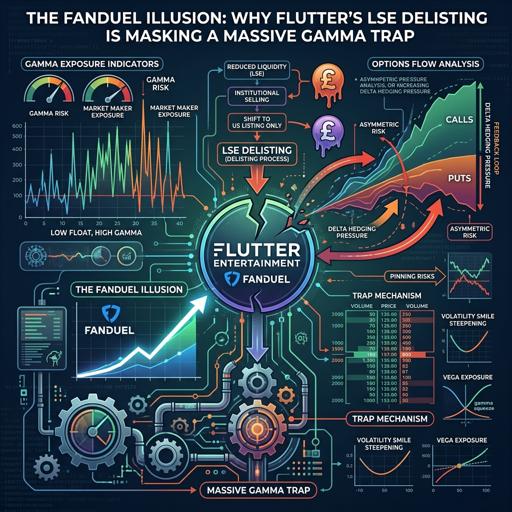
Most of Wall Street is looking at Flutter Entertainment (FLUT) through the wrong end of the telescope. They see the Q1 2026 top-line revenue growth of 17%, the dominance of FanDuel in the US, and they nod in approval. They see the upcoming August 3rd delisting from the London Stock Exchange as a mere administrative housekeeping item. But if you look under the hood at the market plumbing, the structural flows, and the derivatives data, a completely different—and far more violent—narrative emerges.
We are witnessing a textbook forced-flow migration. European passive funds are being forced to puke their shares ahead of the LSE delisting, while aggressive US players, such as billionaire Kenneth Dart, have been quietly accumulating massive notional exposure via Total Return Swaps (TRS) in the $94-$97 range. This dynamic has created severe dislocations in the dark pools and the options market.
The Dark Pool Capitulation
Let's peel back the curtain on the institutional dark pools. When we synthesize the TRF ratio (off-exchange volume percentage), off-exchange short volume percentage, Volume Z-score, and rolling Close Location Value (CLV), a glaring narrative of structural capitulation and stealth accumulation emerges. On June 26, the Volume Z-score exploded to an extreme 2.968, coinciding with the TRF ratio plummeting to its 1.7th percentile—a rare simultaneous extreme that screams a new trend is beginning. This wasn't retail panic; this was the exhaustion of forced institutional selling, absorbed aggressively in the lit markets. Simultaneously, the daily CLV spiked to 0.959, closing near the absolute high of the day, while the 5-day rolling CLV trend sharply inflected upward, indicating intense closing positional strength. This volume-price divergence, where massive lit-exchange liquidity was met with aggressive buying rather than further downside, signaled the exact moment institutions stopped their hidden shorting and flipped to stealth accumulation.
The Dealer Unwind and Tail Risk Accumulation
Looking at the time-series trajectory of the options Greeks, the mechanical unwinding of dealer positioning is the real fuel behind this recent stock rally from the mid-$90s to $111. Back on June 25, the Net DEX hit a suffocating -104 million, indicating overwhelming institutional bearish directional exposure. Fast forward to today, and that Net DEX has violently squeezed back to just -6.5 million. The bearish bets have been obliterated. More importantly, we must watch the Net GEX trend: late June saw deeply negative GEX (-3.3 million), a state where negative gamma amplifies price volatility and creates a mean-reversion vacuum. The moment the Net GEX contraction began, it provided the exact price inflection point for the stock to rebound. Yet, here is the contrarian warning: as the price has rallied, the OTM put/call OI ratio has surged aggressively from 0.37 to a towering 2.11. Smart money is paying up for tail risk protection. They are riding the delta squeeze while simultaneously building a massive vault of downside hedges, anticipating that the current liquidity mirage could shatter at any moment.
The Gamma Trapdoor
The structural snapshot of the options chain confirms we are standing on a gamma-fueled trapdoor. Currently, the price sits at $111.32, marginally breaching the front-month (July 17) call wall at $110, which acts as the ultimate short-term resistance and positive gamma anchor (+785k GEX). However, examining the GEX by expiration reveals a terrifying dichotomy: while the near-term is propped up by positive gamma (+841k for July), the macro term structure is completely dominated by a monstrous negative gamma void in the far end, specifically the September 18 expiration which holds a Net GEX of -2.3 million, anchored by a massive put wall at $100. The term structure dictates the future, and the implied volatility skew confirms the fear—short-term (6-21D) puts command a massive 0.772 IV premium over calls (0.444). The market is pricing in near-term pinning at the call wall, followed by a brutal macro rug-pull once the front-end gamma rolls off.
The Play
The current price action is a mechanical illusion. The LSE delisting flow has forced a temporary short-squeeze, masked as fundamental strength. Institutions have weaponized this rally to buy cheap downside protection, completely skewing the volatility term structure.
If FLUT fails to hold the $110 call wall into the mid-July OPEX, the positive gamma holding up the floor will evaporate. Once that happens, the underlying market mechanics will drag the stock relentlessly toward the September $100 put wall. Do not be the retail liquidity provider buying the breakout here; the smart money is already positioned for the trapdoor to open.
Sponsored