In This Article:
AXTI
The AI Mirage: Why AXTI's 400% Melt-Up is a Ticking Time Bomb
BearishStrongChange from report: -33.1%1M: +75.0%3M: -31.8%
Published on 2026-04-27 by TradeFomo
The Narrative vs. Cold Hard Reality
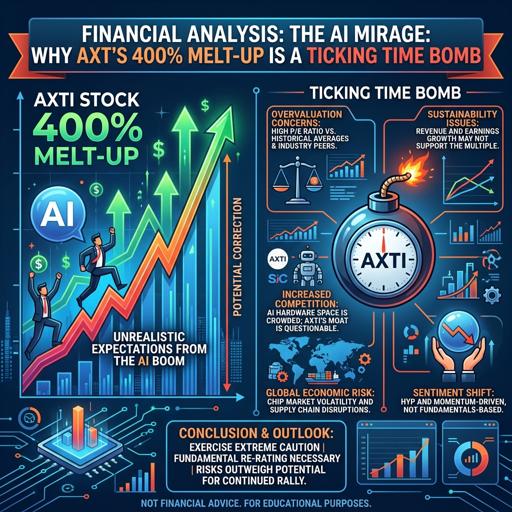
AXT Inc. (AXTI) has orchestrated one of the most breathtaking rallies of the year. Trading under $17 in late January 2026, the stock violently ripped to almost $87 by late April—a staggering 400% gain. The street has swallowed the narrative hook, line, and sinker: Indium Phosphide is the new fundamental building block for AI infrastructure.
The company's April 20 preliminary earnings announcement poured gasoline on the fire, boasting expected Q1 revenues of $26 to $28 million. Retail investors and momentum algorithms are aggressively front-running the upcoming April 30 earnings call, assuming this is the next derivative play in the artificial intelligence supercycle.
But strip away the AI buzzwords, and the fundamentals whisper a much darker truth. Despite the top-line revenue bump, the company is still projecting a net loss. This is not a fundamentally transformed, highly profitable business; it is a legacy semiconductor materials company catching a thematic tailwind. At a nearly $4.9 billion market capitalization, the market has priced in a decade of flawless execution for a company that cannot currently generate a GAAP net profit.
Follow the Insiders, Not the Herd
If the AI substrate revolution is truly upon us, the architects of the company should be diamond-handing their equity. Instead, we are witnessing an absolute executive exodus.
In early March 2026, while the stock was trading in the $30s and $40s, the C-suite ran for the exits. CEO Morris Young liquidated hundreds of thousands of shares, dumping millions of dollars worth of stock in a matter of days through his family trust. CFO Gary Fischer exercised 247,000 options at single-digit strike prices just to immediately flip them onto the open market, offloading over 400,000 shares total. Directors Jesse Chen and David Chang joined the frenzy, aggressively reducing their direct ownership.
When the insiders of a multi-billion dollar company dump shares aggressively into a retail-driven AI narrative, it is rarely just "portfolio diversification." It is a calculated, urgent exit. They left some money on the table as the stock doubled again in April, but smart money knows it is always better to get out three hours early than one minute late.
The Institutional Dark Pool Dance
To truly understand the stealth maneuvers of smart money here, we must examine the interplay of four critical under-the-hood metrics: the TRF ratio (off-exchange trading percentage), the off-exchange short volume percentage, the volume Z-score, and the rolling close location value. Combined, these indicators act as a decoder ring for institutional dark pool activity, exposing hidden accumulation or distribution, abnormal fund flows, and subtle volume-price divergences. It is a structural market law that when the TRF ratio and the volume Z-score hit recent extremes on the exact same day, a violent new directional trend is about to be birthed. We witnessed this in early April—specifically around April 1 and April 9—when massive volume spikes aligned with off-exchange anomalies, fueling the final parabolic leg of the squeeze. Furthermore, the trajectory of the rolling close location value strips away intraday retail noise to reflect the true shift in long and short power at the closing bell. Right now, this metric is flashing a stark warning. The rolling close location value has visibly deteriorated from its mid-April highs. Simultaneously, the off-exchange short volume percentage has spiked right back to extreme levels, hitting the 90th percentile on April 23. This toxic combination—deteriorating closing strength alongside aggressive off-exchange shorting into elevated volumes—is the absolute hallmark of institutional distribution operating under the cover of retail euphoria.
Short Squeeze Exhaustion and Options Market Frenzy
The recent price action has all the fingerprints of a mechanical short squeeze rather than organic, long-term accumulation. The short interest essentially quintupled from roughly 3% last fall to a massive 15.91% by mid-April, with over 8.2 million shares shorted. The retail crowd saw this and applied maximum pressure.
This pressure manifested in the derivatives market. On April 15, options volume exploded to an anomalous 86,796 contracts—translating to over $100 million in notional value in a single session. By April 21, the put/call volume ratio spiked to an extreme 1.88, indicating that institutional players were heavily buying downside protection while the stock hovered near its peak. The recent 13F filings show hedge funds like Citadel, Point72, and Assenagon amassing large positions, but do not mistake them for long-term believers. These are quantitative players exploiting volatility premiums, delta-hedging options flows, and arbitraging the retail momentum.
The Verdict: The April 30 Earnings Trap
AXTI's pre-announcement on April 20 was a masterful stroke of financial engineering. By releasing preliminary top-line revenue beats early, they successfully baited retail momentum traders into providing the necessary exit liquidity for lingering institutional longs.
The technicals are stretched to their absolute limits, RSI indicators have flashed severe overbought warnings multiple times, and the dark pool data indicates institutional shorting is quietly reloading at the top. The upcoming April 30 earnings report is not a catalyst for another leg up to $100. It is the trapdoor opening.