In This Article:
ACAD
The Biotech Anomaly: Why the Street is Dead Wrong on ACADIA Pharmaceuticals
BullishStrongChange from report: +17.1%1M: -6.3%3M: +13.6%
Published on 2026-04-18 by TradeFomo
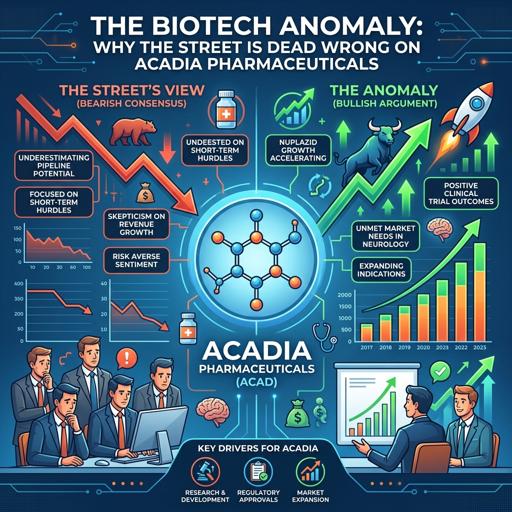
If you want to find genuine alpha in the modern market, you have to look for the divergence between public perception, fundamental reality, and the hidden plumbing of institutional order flow. Currently, there is a glaring, almost violent disconnect happening in ACADIA Pharmaceuticals (ACAD).
The mainstream narrative seems to be pricing ACAD as a struggling biotech facing a cliff. The stock bled out from a peak of $28.35 in early January down to the $19.60s by mid-March. Yet, a look under the hood reveals a cash-printing machine that is quietly being accumulated by major players, culminating in a massive, undeniable structural break in the trading data just days ago.
The Fundamental Disconnect
Before diving into the market microstructure, we have to establish the baseline reality of the business. In late February 2026, ACADIA reported its Q4 and full-year 2025 results. The numbers were nothing short of a blowout.
The company generated $1.07 billion in full-year revenue, driven by NUPLAZID and the continued hyper-growth of DAYBUE. More importantly, ACAD reported a staggering net income of $274 million for Q4 alone (bringing the full year to $391 million). They are sitting on an $820 million war chest of cash and equivalents. They provided 2026 revenue guidance up to $1.28 billion.
Despite this, the stock sold off through March. Why? The market is overly obsessed with pipeline anxiety—specifically, the pending Phase 2 results for remlifanserin later this year. Retail investors panicked, but the "smart money" didn't. Baker Bros. Advisors, one of the most ruthless and successful biotech funds in the world, recently filed a 13D/A showing they hold a massive 25.3% stake (over 43 million shares) in the company. You do not hold a quarter of a billion-dollar biotech company if you expect the core business to implode.
The Hidden Institutional Hand: A Microstructure Masterclass
To understand the sheer magnitude of the mispricing and the impending reversal, we must analyze the structural order flow. When we synthesize the off exchange transaction ratio (TRF ratio), the off exchange short percentage, the Volume Z-score, and the rolling close location value (CLV), a crystal-clear narrative of institutional suppression and explosive capitulation emerges.
Throughout March and early April, ACAD was trapped in what our data classifies as a "very bear" micro-state. During this bleed-out, we saw consistently elevated off exchange transaction ratios (frequently hitting the 80th to 98th percentiles) combined with high off exchange short percentages. Institutions were routing their shorting and suppression tactics through dark pools to avoid public price discovery, keeping retail sentiment bleak. Correspondingly, the rolling close location value (CLV) remained heavily depressed, frequently hovering near zero, meaning the stock was being forced to close at the absolute daily lows to maximize psychological pain.
However, Friday, April 17, 2026, marked a violent paradigm shift. The Volume Z-score exploded to an astronomical +5.79, accompanied by over 8.5 million shares traded—more than 5.5 times the normal volume. Crucially, on this exact day of massive volume, the off exchange transaction ratio plummeted to the 1st percentile (0.0167). What does this mean? The action aggressively shifted out of the dark pools and onto the lit exchanges. Combined with a daily CLV spiking to 0.8095 (closing near the high of the massive daily range), this was not retail buying. This was an undeniable institutional short-covering panic and aggressive public accumulation event. When a monumental Volume Z-score coincides directly with a sheer drop in the TRF ratio and a surging CLV, it historically marks the birth of a powerful new bullish trend. The suppression spring has snapped.
Insider Conviction and Technical Capitulation
If the fundamentals are deteriorating, insiders are the first to run for the exits. Yet, a review of recent SEC filings shows a completely different story.
Throughout March and April, key executives—including CEO Catherine Owen Adams, CFO Mark Schneyer, and Chief Legal Officer Jennifer Rhodes—have been acquiring massive tranches of shares via RSUs and options. The only selling occurring on the tape are the automated, mandatory "sell-to-cover" transactions required for tax withholding purposes under Rule 10b5-1 plans. Nobody is dumping their core holdings. In fact, the Board just added a new director, Jonathan Poole, signaling further stabilization and governance confidence.
The Technical Exhaustion
The technical data perfectly aligns with the order flow anomaly of April 17. The algorithm flagged multiple "potential bottom" signals originating in mid-March, perfectly tracking the multi-timeframe lows. Furthermore, MACD generated a "golden cross below zero" in late March.
The heavy options open interest—particularly the massive put/call ratios seen in the mid-summer expirations—suggests that the market has been overly hedged for a downside scenario that is fundamentally unsupported. As the stock breaks upward, delta hedging by market makers will force them to buy the underlying stock to cover these underwater puts, creating a synthetic tailwind.
The Verdict
The market is a weighing machine in the long run, but a voting machine in the short run. For the past two months, dark pool mechanics and pipeline paranoia allowed institutional players to cast negative votes, driving ACAD's price down to illogical levels.
With $1.07 billion in revenue, massive profitability, zero insider panic, and a 25% backing from Baker Bros, the downside thesis is exhausted. The explosive lit-exchange volume on April 17 is the smoking gun. The dark pool suppression has ended, the shorts are trapped, and the great repricing of ACADIA Pharmaceuticals has begun.