In This Article:
ACAD
The Asymmetric Disconnect: Why Wall Street is Mispricing ACADIA's $1 Billion Transformation
BullishStrongChange from report: +24.7%1M: +7.5%3M: +21.4%
Published on 2026-03-27 by TradeFomo
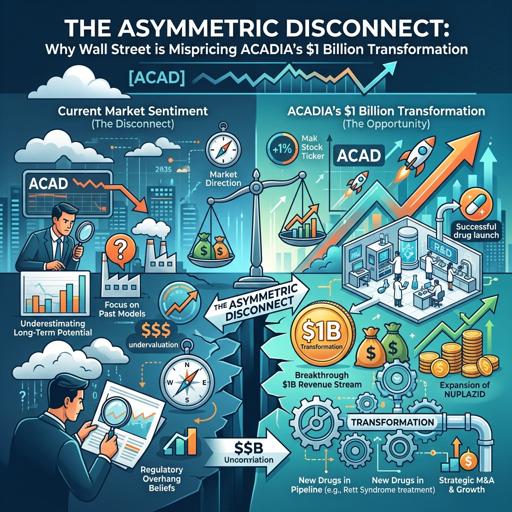
The market is an emotional pendulum, constantly oscillating between irrational exuberance and unjustified despair. Right now, in the spring of 2026, the pendulum for ACADIA Pharmaceuticals (ACAD) has swung so far into the territory of despair that the algos and passive funds have completely blinded themselves to the underlying math.
ACAD is currently trading at $21.47, down nearly 20% over the last three months. If you look at a surface-level stock screener, you see a biotech stock drifting downward, accompanied by a slew of recent "insider selling" filings and a scary-looking Vanguard exit.
But if you actually dig into the filings, the financial realities, and the upcoming clinical catalysts, a completely different picture emerges. This isn't a melting ice cube; it's a cash-gushing machine being priced for zero pipeline success.
The Financial Reality: Ignoring $391 Million in Net Income
In an era where most mid-cap biotechs are incinerating cash and diluting shareholders to keep the lights on, ACADIA just posted a masterclass in profitability.
In their full-year 2025 earnings reported in late February, ACAD crossed the psychological and financial Rubicon: $1.07 billion in full-year revenue (up 12% YoY). Even more impressively, they generated $391 million in net income, with $274 million of that hitting in Q4 alone. DAYBUE net sales are up 13% YoY, and the company is guiding for $1.22 to $1.28 billion in top-line revenue for 2026. They are sitting on an $820 million war chest of cash and investments.
Yet, the market has rewarded this execution by chopping the stock down from its late-2025 highs of ~$28 to $21. Wall Street is obsessing over minor Inflation Reduction Act (IRA) rebate accrual charges on NUPLAZID, treating a temporary margin haircut as a terminal disease. At a $4.45 billion market cap, backed by $820 million in cash, the market is assigning a remarkably low multiple to a highly profitable, billion-dollar revenue stream.
The Mirage of "Insider Dumping" and Institutional Flight
To understand why the stock is artificially suppressed, you have to understand how algorithmic trading misreads SEC filings.
If you scrape the recent Form 4s from late March 2026, you see a wave of red:
- CEO Catherine Owen Adams sold 11,641 shares.
- CFO Mark C. Schneyer sold over 7,300 shares.
- Chief Legal Officer Jennifer Rhodes sold 3,844 shares.
A superficial scan screams "insiders are abandoning ship!" But read the footnotes. These transactions (executed around March 25-26) were strictly automated Rule 10b5-1(c)(1)(i)(B) sales to cover tax withholding obligations tied to massive Restricted Stock Unit (RSU) vests. The C-suite isn't bailing; they just acquired massive tranches of options and RSUs (the CEO alone was granted 263,000 options and 76,000 RSUs on March 6). They are fundamentally long and deeply entrenched in the company's upside.
Furthermore, look at the recent Schedule 13G/A filed by Vanguard on March 26, reporting "zero" beneficial ownership. A lazy analyst assumes Vanguard dumped their position. Read the filing: it explicitly states this was an internal realignment where subsidiaries will now report on a disaggregated basis. Vanguard didn't sell; they just shuffled their paperwork.
Meanwhile, the smartest money in biotech—Baker Bros. Advisors—filed an amended 13D in late February confirming a mammoth 43.15 million share stake. They own 25.3% of the entire company. Baker Bros. doesn't hold a quarter of a $4 billion company unless they see a multi-bagger exit.
The Free Option: ACP-204 and the Alzheimer's Catalyst
The greatest asymmetry in the market occurs when you can buy a strong base business for a fair price and get a massive pipeline catalyst for free. ACAD is currently priced entirely on the cash flows of NUPLAZID and DAYBUE. The market is assigning essentially zero value to their pipeline.
Between August and October 2026, ACADIA will report Phase 2 results for ACP-204 (remlifanserin) in Alzheimer's Disease Psychosis. This is a staggering Total Addressable Market (TAM). The socio-economic burden of Alzheimer's psychosis is a crisis, and the regulatory environment is desperate for efficacious interventions with clean safety profiles. If ACP-204 shows strong Phase 2 efficacy, the stock will violently reprice to account for a multi-billion dollar peak sales opportunity. If it fails, the downside is heavily buffered by the existing $1.25B base business and the $820M cash pile.
Secondary Pipeline Shots on Goal
Beyond ACP-204, the pipeline is quietly maturing. They are actively recruiting for Phase 2 trials of ACP-211 for Major Depressive Disorder (MDD) and Pimavanserin for rigid-compulsive symptoms in Autism Spectrum Disorder. These are not niche indications; these are blockbuster TAMs.
Blood in the Streets: The Technical Setup
For those who respect the tape, the technicals align perfectly with the fundamental disconnect. ACAD's chart throughout Q1 2026 has been a graveyard of retail sentiment, but the underlying momentum indicators are screaming "exhaustion."
- Oversold Extremes: On February 12, the RSI plummeted to 24.9, a deeply oversold condition.
- Multi-Timeframe Bottoms: Our quantitative models flagged multi-timeframe "potential bottom" signals repeatedly through March, specifically locking in on the $20.32–$21.00 range as a heavy accumulation zone.
- MACD Golden Cross: On March 25, 2026, the MACD generated a golden cross below the zero line, historically a high-probability reversal signal for technically suppressed assets.
The Contrarian Verdict
You rarely get the chance to buy a profitable, $1 billion+ revenue biotech, sitting on almost a billion in cash, while the market treats it like a clinical-stage coin flip.
The algos are selling on phantom insider dumping and misunderstood institutional filings. The analysts are hyper-fixated on quarter-to-quarter IRA rebate semantics. Meanwhile, the Baker Brothers are sitting on 25% of the float, waiting for the Alzheimer's Psychosis data later this year.
ACAD offers a classic margin of safety with a heavily mispriced lottery ticket attached. Wall Street is looking backward; the real alpha lies in looking forward to Q3.