In This Article:
ABUS
The $2.25 Billion "Sell The News" Illusion: What Dark Pools Are Hiding in Arbutus Biopharma
BullishStrongChange from report: -0.2%1M: +0.0%3M: +6.0%
Published on 2026-04-14 by TradeFomo
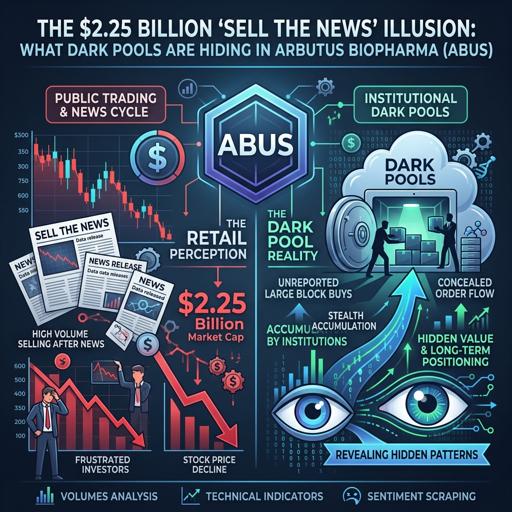
When a small-cap biotech secures a multi-billion dollar settlement against a pharmaceutical titan, the market's reaction is entirely predictable: an initial violent spike, followed by a prolonged, agonizing bleed as the "sell the news" crowd takes their profits and moves on.
This is exactly what the surface-level chart of Arbutus Biopharma (ABUS) suggests. On March 3, 2026, ABUS and Genevant announced a $2.25 billion settlement with Moderna over lipid nanoparticle (LNP) patent infringement. The stock surged on abnormal volume—hitting a high of $4.81—and has spent the last month slowly bleeding back down to the $4.15 level. Retail investors are frustrated. Momentum algorithms have flipped short. Technical indicators, like the early April MACD dead cross, look dismal.
But if you only look at the surface, you are exactly the kind of liquidity provider institutions rely on. When we peel back the tape and look at the underlying mechanics of off-exchange routing, a wildly different, highly contrarian thesis emerges: the post-settlement "bleed" is a carefully orchestrated illusion masking one of the most aggressive institutional accumulation phases we've seen this year.
The Anatomy of Off-Exchange Accumulation
To understand what is truly happening with ABUS, we have to look away from the lit exchanges and dig into the dark pools where the real money moves.
By analyzing the intricate interplay of four critical metrics—trf_pctile (Off-exchange/TRF volume ratio), short_pctile (TRF shorting percentage smoothed over 3 days), vol_z_score (20-day Volume Z-score), and cpv_ewma_5 (5-day Rolling Close Position Value)—we uncover the hidden mechanical footprint of institutional behavior. A coincident spike in both the TRF ratio and the Volume Z-score is historically the clearest signature of a trend exhaustion and the violent birth of a reversal. In ABUS, this tetrad of indicators has just flashed a definitive signal. On April 8 and again on April 10, the trf_pctile slammed into the absolute maximum (1.0, or the 100th percentile), accompanied by an elevated positive vol_z_score. At the exact same time, the short_pctile plummeted to the 1st and 3rd percentiles (0.016 and 0.033, respectively). This means that while dark pool volume was hitting its absolute peak, almost none of it was short selling. This is the smoking gun of naked, aggressive institutional accumulation, not distribution. Furthermore, while the rolling CPV initially compressed during this period—creating a false visual of directional price weakness on the daily chart—it masked the reality that shares were being vacuumed up at the bid. By April 13, the daily CPV violently snapped back to 0.96, confirming that the bulls had completely absorbed the overhead supply and regained control of the closing price. This severe divergence between a bleeding surface price and maxed-out long off-exchange volume screams that smart money is quietly hoarding shares from exhausted retail hands before the next leg up.
The 13D Validation: Catching the Whales in Real Time
We don't have to guess if institutions were buying that exact dip; the SEC filings just proved it.
On April 13, 2026, Whitefort Capital Management filed a Schedule 13D/A revealing they had increased their stake in ABUS to 8.1%, up to 15.79 million shares. When did they buy? Through a series of open-market purchases between March 3 and April 10 at prices ranging from $4.12 to $4.25.
Look at those dates. They align flawlessly with the exact window where our dark pool data registered absolute maximum trf_pctile and near-zero short_pctile. While retail traders were panic-selling the post-Moderna bleed, Whitefort was using off-exchange facilities to swallow millions of shares at a discount without spiking the lit market price. Two Seas Capital LP and Morgan Stanley executed similar maneuvers late last year, scooping up massive positions while the stock consolidated.
The Fundamental Mispricing
Why is smart money loading the boat at $4.15? Because the market is severely mispricing the structural floor of this company.
Let’s do the math. ABUS ended 2025 with $91.5 million in cash. Under the Moderna settlement, ABUS is entitled to 20% of the $950 million non-contingent upfront payment, which translates to $190 million in hard cash coming by July 2026.
That puts Arbutus’s pro-forma cash pile at roughly $281.5 million. At a current share price of $4.37, the market cap is roughly $854 million. This means the market is assigning an enterprise value of just ~$570 million to the rest of the company.
What does that $570 million get you?
- The Pfizer/BioNTech Lawsuit: Moderna just caved for $2.25 billion. Pfizer's COMIRNATY generated comparable, if not higher, historic revenues. The precedent is now set, and ABUS has the leverage.
- The Clinical Pipeline: Arbutus is not a patent-troll shell company; they are an active clinical-stage biotech. Their Phase 2a trials for imdusiran (AB-729) are showing functional cures for chronic Hepatitis B (cHBV) in multiple patients. A functional cure for Hep B is a holy grail in hepatology, easily worth a multi-billion dollar valuation on its own if Phase 3 looks anything like Phase 2a.
The Coiled Spring
The market fundamentally misunderstood the Moderna settlement. It was not the end of the story; it was the capitalization event that derisked the entire pipeline and funded the upcoming war with Pfizer.
Right now, the stock is trapped in a classic liquidity transfer phase. The surface-level technicals look weak by design, encouraging impatient retail capital to exit. Meanwhile, beneath the surface, the TRF volume data and 13D filings explicitly show institutional whales establishing a floor.
When dark pool accumulation of this magnitude occurs against a backdrop of a newly fortified balance sheet and an impending catalyst (the Pfizer litigation schedule and Hep B data readouts), the result is a coiled spring. The "bleed" is over; the smart money is already positioned for the re-rating.